
Anthropic released an upgraded version of its flagship model, Claude Opus 4.7, on April 16 (local time). Compared to the previous Opus 4.6 model, Opus 4.7 demonstrates “significant improvements” in advanced software engineering capabilities, particularly on difficult tasks, with enhanced rigor and consistency in complex, long-running operations and improved vision abilities. However, Anthropic deliberately weakened the model’s cybersecurity attack-defense capabilities during training and introduced safety mechanisms to automatically detect and block prohibited or high-risk requests.
Performance and Benchmarks
In benchmark testing, Opus 4.7 achieved scores generally higher than the previous Opus 4.6 and competitor GPT-5.4. However, Anthropic emphasized that Opus 4.7’s overall capabilities do not match the company’s most powerful model, Claude Mythos Preview. According to Anthropic: “By deploying and operating these protective mechanisms in the real world, we will accumulate experience to ultimately enable broader release of Mythos-level models.”
Deployment and Pricing
Opus 4.7 is now live across all Claude products and API interfaces, integrated with Amazon Bedrock, Google Cloud Vertex AI, and Microsoft Foundry services. Pricing remains consistent with Opus 4.6: $5 per million input tokens and $25 per million output tokens.
Token Consumption Changes
Two changes in Opus 4.7 compared to Opus 4.6 will affect token usage. First, Opus 4.7 uses an updated tokenizer, improving how the model processes text. However, this means identical inputs may consume more tokens—approximately 1 to 1.35 times the previous generation’s consumption.
Second, Opus 4.7 performs more reasoning at higher “thinking intensity,” particularly in subsequent rounds of agentic scenarios. This improves reliability on complex problems but generates additional output tokens.
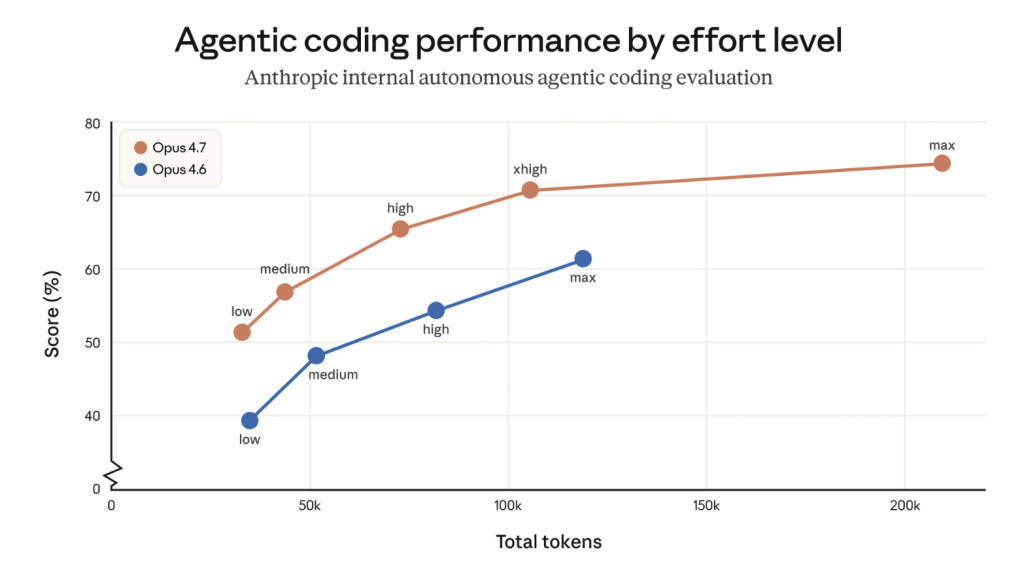
 Opus 4.7 token consumption increase. Source: Anthropic
Market Analysis and Context
Analysts characterize Opus 4.7 as a “transitional” model. Investment analyst Adam Button noted that the Opus 4.7 release reinforces Anthropic’s narrative around “godlike models” like Mythos and confirms market skepticism: publicly available paid models are essentially “lite” versions constrained by safety mechanisms.
Company Background and Financial Milestone
Anthropic, founded in 2021 by former OpenAI employees, develops the Claude series of large language models. On April 6, Anthropic announced its annualized revenue (ARR) exceeded $300 billion, a significant increase from $9 billion at the end of 2025. The company is actively pursuing an initial public offering.
Cybersecurity Risk Concerns
Anthropic executives have repeatedly warned about AI’s impact on cybersecurity. According to reports dated April 10 (local time), U.S. Treasury Secretary Yellen and Federal Reserve Chair Powell held an emergency meeting with Wall Street leaders on April 7 to discuss how Anthropic’s latest Mythos AI model could heighten cybersecurity risks. Anthropic has stated that Mythos is not suitable for public release because the model could be misused by cybercriminals and spies. The company is selectively providing access to Mythos to leading global cybersecurity and software enterprises.
免责声明:以上内容(如有图片或视频亦包括在内)均为平台用户上传并发布,本平台仅提供信息存储服务,对本页面内容所引致的错误、不确或遗漏,概不负任何法律责任,相关信息仅供参考。
本站尊重他人的知识产权、名誉权等法律法规所规定的合法权益!如网页中刊载的文章或图片涉及侵权,请提供相关的权利证明和身份证明发送邮件到qklwk88@163.com,本站相关工作人员将会进行核查处理回复